When you’re building a project car, it’s easy to get caught up in the “big” mods. You spend months researching turbo kits, debating the best ECU tunes, or picking out the perfect set of coilovers to get that aggressive stance. But there is one critical step that often gets treated as an afterthought or a “quick fix” at the end of a build: the wheel alignment.
For a daily driver, a standard alignment is just about keeping the car from pulling to the left or right. But for high-performance builds throughout Long Island, the alignment is what actually connects all those expensive parts to the pavement. It is the final bridge between a collection of high-end components and a car that actually handles like it’s on rails. If you’ve invested in suspension modifications, skipping a precision alignment is like buying a high-end tuxedo and never getting it tailored: it just won’t perform the way it was meant to.
At All Out Motorworks, we see it all the time. A driver comes in with a beautiful BMW or Audi build, complaining that the car feels “nervous” at high speeds or doesn’t “bite” into the corners like it should. Usually, the culprit isn’t the parts; it’s the geometry. Let’s dive into the technical reasons why a professional wheel alignment in Hicksville is the most important “hidden” mod you can give your car.
The Secret to “Turn-In”: Mastering Camber and Caster
If you’ve ever driven a professional race car or a well-sorted track build, you’ve felt that instant, razor-sharp response the moment you turn the steering wheel. That feeling is called “turn-in,” and it is almost entirely dictated by your alignment settings: specifically camber and caster.
Negative Camber: The Cornering King
Camber is the inward or outward tilt of the wheels when viewed from the front. Most street cars come from the factory with a very slight amount of negative camber for stability. However, when you’re pushing a car through a sharp bend near Long Island, centrifugal force causes the car to lean. This lean rolls the tire onto its outer edge, reducing the contact patch and causing the front end to “push” or understeer.
By dialing in more aggressive negative camber, we ensure that when the car leans during a turn, the tire rolls into a perfectly flat position. This maximizes the rubber on the road exactly when you need it most. The result? A car that feels glued to the asphalt and offers significantly higher mid-corner speeds.
Positive Caster: Steering Feel and Stability
Caster is the angle of the steering pivot when viewed from the side. While it doesn’t affect tire wear as much as camber or toe, it is the secret sauce for steering feel. High-performance builds benefit from increased positive caster because it improves “straight-line” stability and provides that satisfying “self-centering” feel in the steering wheel. More importantly, caster creates “dynamic camber,” meaning the wheels actually gain more negative camber as you turn them, giving you the best of both worlds: stability on the highway and grip in the tight stuff.
Correcting Modified Geometry: Beyond the Factory Specs
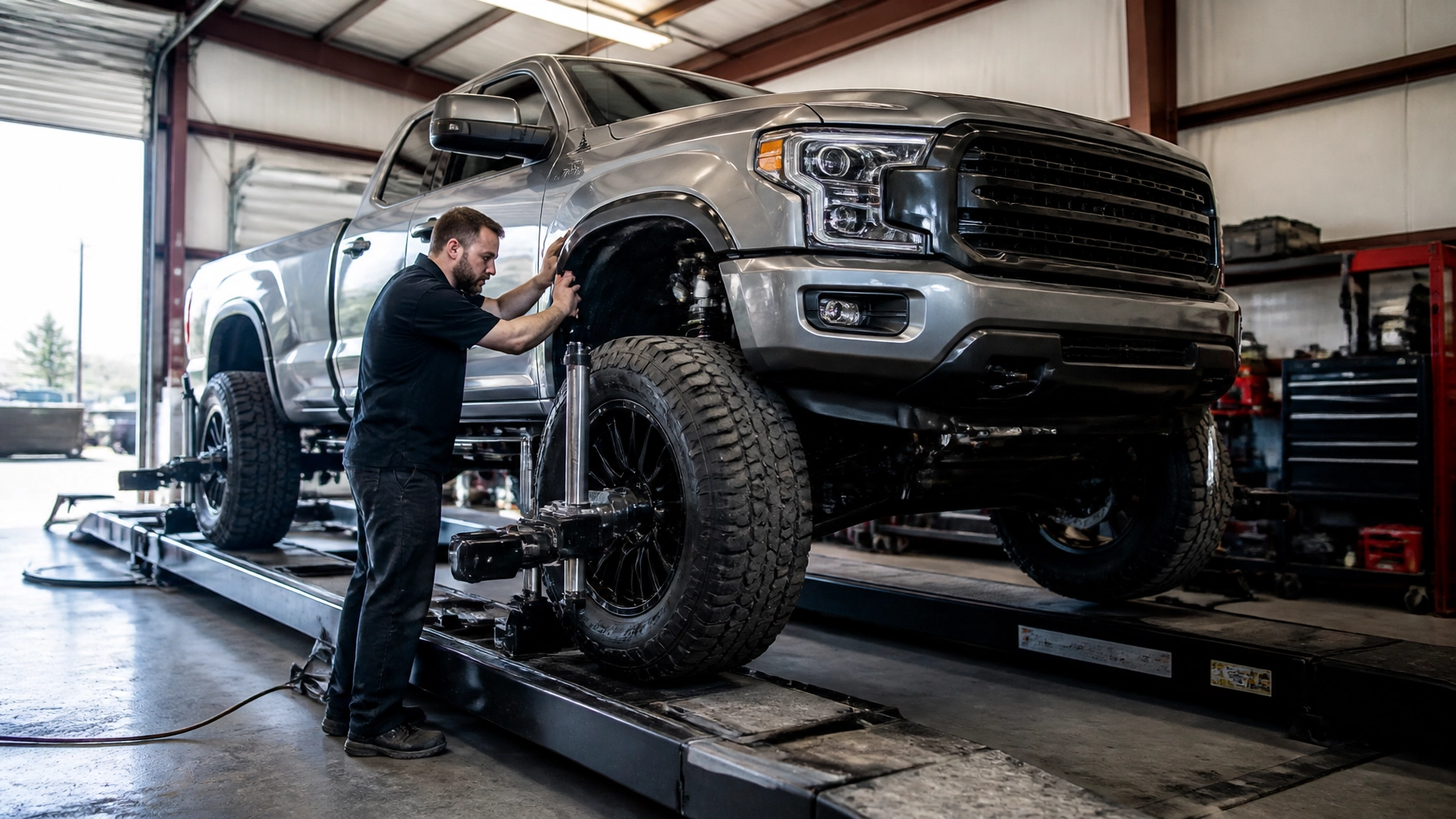
One of the biggest mistakes enthusiasts make is taking a modified car to a standard “big-box” tire shop and asking for a factory alignment. Factory specs are designed for factory ride heights and factory bushings. The moment you lower your car or install a lift kit, those factory numbers often become irrelevant.
When you lower a vehicle, the suspension arms move through their arc, naturally creating more negative camber and often changing the “toe” settings. This is known as “bump steer,” where the car’s wheels actually steer themselves as the suspension compresses over bumps. For drivers in Hicksville, where the roads aren’t always glass-smooth, bump steer can make a high-performance car feel terrifyingly unpredictable.
A professional performance alignment involves more than just “getting it in the green.” It involves understanding the new geometry of your custom build. We look at how the suspension moves under load and adjust the pivot points: sometimes using adjustable control arms or camber plates: to ensure the geometry works with your new ride height, not against it.

The ROI of Alignment: Protecting Your Tire Investment
High-performance tires are expensive. Whether you’re running Michelin Pilot Sports or a dedicated track compound, the last thing you want is to “cord” a tire in 3,000 miles because your toe settings were off.
While many people blame camber for tire wear, “toe” is actually the biggest tire killer. Toe refers to whether the tires are pointing toward each other (toe-in) or away from each other (toe-out) when viewed from above. Even a tiny fraction of an inch of “toe-out” on a street car acts like a giant sandpaper block, scrubbing the rubber off your tires every foot you drive.
In a performance setting, we might use a tiny bit of toe-out to help the car rotate better, but it has to be balanced. A professional alignment ensures that your tires wear as evenly as possible given your driving style. For the enthusiast who daily drives their project car, we can find that “Goldilocks” setting: enough aggressive geometry to make the car fun on the weekends, but conservative enough that you aren’t buying new tires every six months.
Why Technical Expertise Matters
At All Out Motorworks, we aren’t just reading numbers off a screen. We are Technet certified professionals who understand the “why” behind the settings. We work with you to understand your budget and your goals. Are you building a dedicated drag car that needs maximum rear-end “bite”? Or a canyon carver that needs to feel nimble and light?
Every build is different. A lifted truck getting a lift kit installation requires a completely different alignment strategy than a slammed Audi on air suspension. We take the time to explain the process and ensure that your vehicle leaves our shop safer, faster, and more predictable than when it arrived.
Conclusion: Don’t Leave Performance on the Table
A high-performance build is a labor of love. You’ve spent the time and money to choose the best parts, from engine swaps to custom exhaust setups. Don’t let a poor alignment be the weak link in your chain.
A professional wheel alignment is the final calibration that makes your car feel like a cohesive machine. It protects your tires, improves your safety, and: most importantly: unlocks the true handling potential of your modifications. If you’re around Hicksville or anywhere throughout Long Island, it’s time to stop settling for “good enough” alignments.
Ready to see what your car can really do?
Bring your build to All Out Motorworks. Whether you need a precision alignment for your daily driver or a full custom setup for your performance project, our team is here to help. We offer transparent pricing, nationwide warranty coverage, and the expertise your vehicle deserves.
Contact us today to schedule your professional wheel alignment and experience the difference that precision makes!